
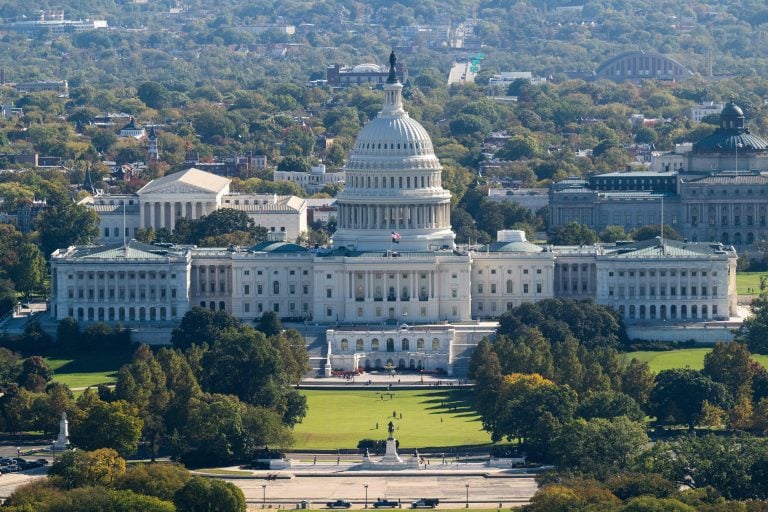

The United States is heading into the final days before the November 3 midterm elections with Republicans under pressure in both chambers of Congress.
The picture is clearest in the House of Representatives.
The RealClearPolitics average of national generic congressional polls gives Democrats 51.4 percent support against 43.2 percent for Republicans — an advantage of 8.2 percentage points. Individual polls conducted in the second half of October have generally put the Democratic lead somewhere between four and eleven points.
The nonpartisan Cook Political Report has also continued moving House races towards Democrats.
As of October 30, Cook rates 222 seats as Solid, Likely or Lean Democratic, already above the 218 required for a majority. Another 18 races are rated Toss Ups. Cook now estimates that Democrats could gain between 12 and 25 seats, potentially giving them as many as 240 seats in the new House.
That is a marked deterioration for Republicans even compared with mid-October, when the prospect of losing the House was already causing concern inside the party.
Prediction markets tell a similar story, although they measure traders’ expectations rather than voter intentions. On October 30, Polymarket priced a Democratic House victory at 94 percent, while Kalshi put the probability at 91 percent two days earlier.
Senate is much tighter
The Senate is a different story. Democrats need a net gain of four seats to take control, and the map initially appeared highly favourable to Republicans.
But the national political environment has brought several Republican-held seats into play.
Cook now rates seven Senate races as Toss Ups: Alaska, Iowa, Kansas, Maine, Michigan, Ohio and Texas. Six of those seats are currently held by Republicans; Michigan is the only Democratic-held seat in the group. North Carolina, another Republican-held seat, is now rated Likely Democratic.
That gives Democrats a plausible route to a majority, but one that requires them to win several close races simultaneously.
If they hold Michigan and other Democratic seats while flipping North Carolina as Cook’s current rating suggests, they would still need three additional Republican-held seats to reach a majority.
Several of those contests are extremely close.
In Texas, the RealClearPolitics average has Democrat James Talarico ahead of Republican Ken Paxton by 1.8 points, 48.8 to 47.0. In Iowa, Republican Ashley Hinson leads Democrat Josh Turek by only half a point.
In traditionally Republican Kansas, Democrat Adam Hamilton leads Republican Senator Roger Marshall by 2.6 points in the RCP average. Donald Trump carried Kansas by more than 16 points in 2024.
Former Democratic Senator Sherrod Brown is meanwhile ahead by 2.6 points in the Ohio average, another state Trump won comfortably in 2024.
Democrats are also competitive in Alaska, where former congresswoman Mary Peltola holds a narrow polling lead over Republican Senator Dan Sullivan, and in Maine, where Democrat Troy Jackson leads Republican Senator Susan Collins by 1.4 points in the polling average.
Michigan remains crucial because Democrats cannot afford to surrender one of their own seats while trying to make gains elsewhere. Democrat Abdul El-Sayed currently leads Republican Mike Rogers by 3.2 points in the RCP average, but Cook still classifies the race as a Toss Up.
The prediction markets currently lean towards a Democratic Senate as well, but much less decisively than in the House. Polymarket put the probability of Democratic control at 69 percent on October 30, while Kalshi had it at 65 percent on October 28.
Those numbers can change quickly and should not be treated as opinion polls or conventional election forecasts.
Trump dragged down by cost of living
The broader political environment is one of the biggest problems facing Republicans.
A Reuters/Ipsos poll conducted October 22–26 put Trump’s overall approval rating at just 32 percent. Only 25 percent approved of his handling of the economy, and 20 percent approved of his handling of the cost of living. Among likely voters, Democrats led Republicans by nine points on the congressional ballot.
The cost of living has become the dominant issue of the campaign. In an earlier Reuters/Ipsos survey, 47 percent of registered voters named it as the single most important factor in deciding their midterm vote.
One highly visible part of that problem is fuel.
The war with Iran has contributed to a major increase in oil and gasoline prices. According to the US Energy Information Administration, regular gasoline averaged $4.27 per gallon nationally on October 26. AAA put the national average at $4.22 on October 29.
Associated Press reports that gasoline was around $2.98 a gallon before the war with Iran began in February. By late October, prices were roughly $1.30 higher. Diesel prices have risen even more sharply, adding costs throughout transport, agriculture and supply chains.
The war itself has also become unpopular. An AP report in October found that 69 percent of Americans believed the conflict had not been worth fighting, while only 28 percent approved of Trump’s handling of it.
That does not mean fuel prices alone explain the Republican difficulties. Polling shows broader dissatisfaction over household costs, the economy and Trump’s job performance. But the Iran war has made the affordability problem unusually tangible every time voters fill their cars.
House advantage is clear, Senate could go either way
With only days remaining, the different dynamics of the two chambers are striking.
National polling, Cook’s district ratings and prediction markets all currently show Democrats in a substantially stronger position in the House. Republicans would need to outperform the present national environment across a large number of competitive districts to retain control.
The Senate remains considerably less certain.
Democrats have put Republican seats in states such as Texas, Kansas, Ohio, Iowa and Alaska into serious contention, something that would have looked unlikely earlier in the cycle. But because they need four net gains, one loss of their own — particularly in Michigan — would make the path significantly harder.
Cook’s latest map leaves seven Senate races in the Toss Up category. That is why a Democratic wave in the House would not automatically produce Democratic control of the Senate.
The House contest now revolves largely around the scale of potential Republican losses. The Senate contest still revolves around who can win the closest races.
The Cook Political Report is issuing our closing analysis of the battle for the Senate. We are keeping our latest range unchanged — we expect Democrats to pick up between two and six seats. pic.twitter.com/NxuTxbs1R6
— Cook Political Report (@CookPolitical) October 30, 2026
We’re now projecting Democrats will flip 12 to 25 seats, giving them as many as 240 seats in the House. pic.twitter.com/M4hE5oVQyf
— Cook Political Report (@CookPolitical) October 30, 2026