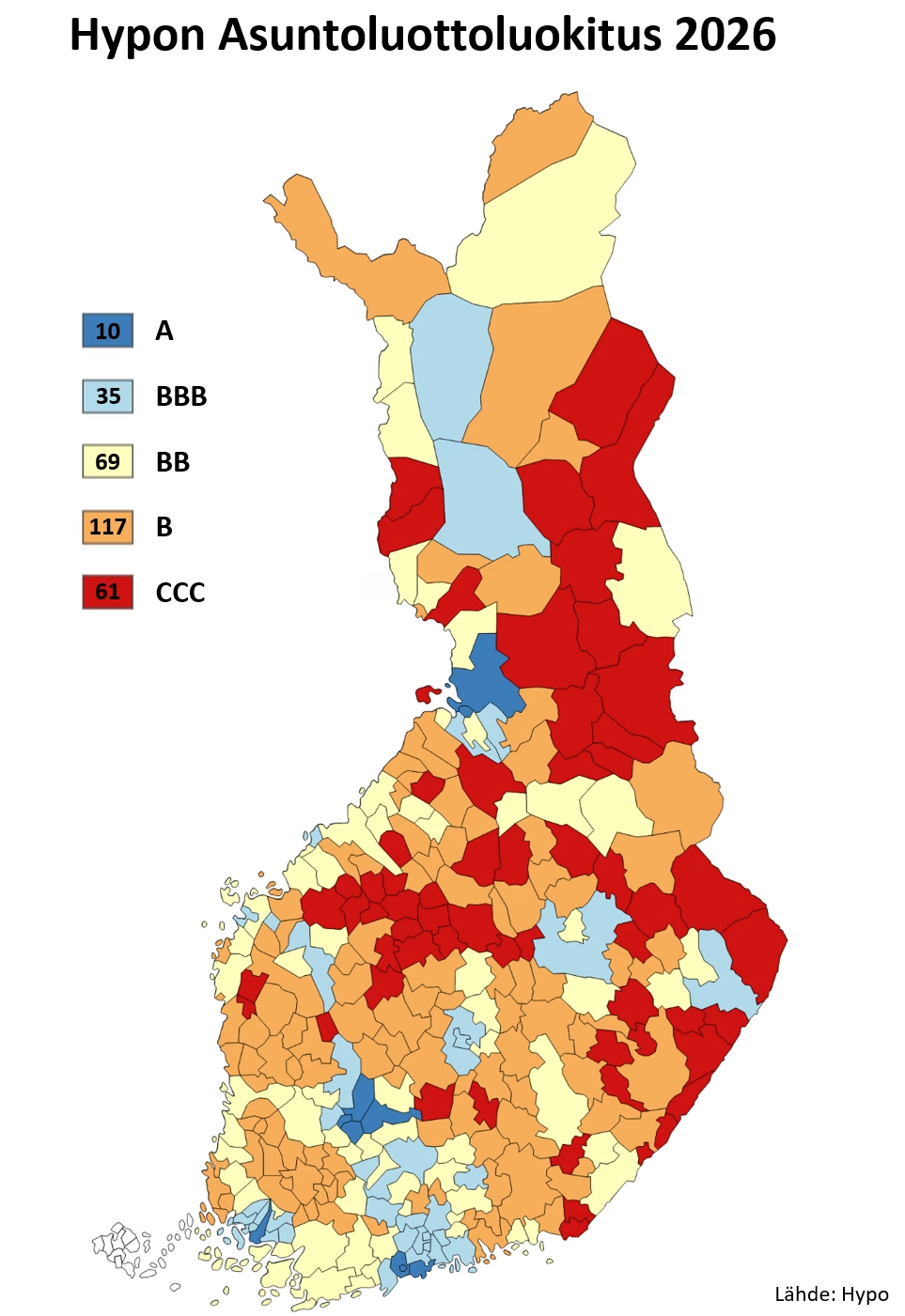

Only ten Finnish municipalities reached the A category in Hypo’s housing market credit rating this year, down from 13 in the previous assessment.
Just 45 municipalities received a rating of BBB or higher, although they are home to 61 percent of the population of mainland Finland. A total of 61 municipalities were placed in the lower C-rated categories.
The Hypo rating, now calculated for the seventh time for every municipality in mainland Finland, assesses regional housing market risks and resilience. Each municipality also receives a positive, stable or negative outlook indicating the strength of its current rating and the risk of a change as economic conditions improve or weaken.
The Tampere region dominates the top of the ranking. Pirkkala retained its A+ rating, while four of the ten municipalities in the A group are located in the Tampere area.
The combined population of the municipalities currently in the A group has increased by more than 120,000 over the past five years.
Turku, meanwhile, has recorded three consecutive years of record population growth. Its outlook improved from negative to stable, although its attractiveness has not boosted neighbouring municipalities’ ratings as strongly as in the Tampere region.
Helsinki has also reversed its migration balance with neighbouring Vantaa. Vantaa’s population growth slowed last year to its weakest relative pace since 1970, while Helsinki recorded net migration from Vantaa for the first time in 30 years. Vantaa has now posted a domestic migration loss for five consecutive years and is rated BBB.
Data centres offer new growth opportunities
Regional differences in Finland’s housing market risks continue to widen, but major data centre projects and investments linked to the green transition are creating new opportunities outside the country’s traditional growth centres.
For the first time, Hypo’s rating takes into account estimates of permanent jobs created by confirmed major investments due for completion between 2025 and 2030.
“Investments worth billions can also create growth opportunities for small municipalities. They can strengthen the local economy and stimulate both housing transactions and rental markets even in areas losing population, although house prices may not rise,” Hypo chief economist Juho Keskinen said in a statement.
Employment is expected to be created not only at data centres themselves but also in supporting activities such as maintenance, services, cleaning and accommodation.
The construction phase can sharply increase demand for rental housing and temporary accommodation both in the municipalities hosting the investments and in neighbouring areas. Permanent jobs may later also create demand in the owner-occupied housing market.
According to Keskinen, the longer-term impact will depend heavily on whether new businesses, education and innovation activity develop around the data centres.
“There are signs of this happening, but we would like to see more,” he said.
Municipalities in Hypo’s A group
Pirkkala A+
Espoo A
Helsinki A
Kempele A
Lempäälä A
Oulu A
Tampere A
Turku A
Kangasala A-
Kauniainen A-