
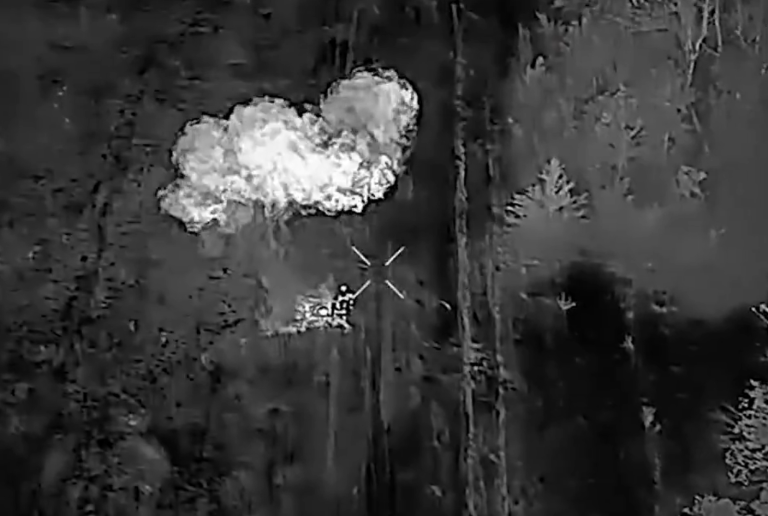
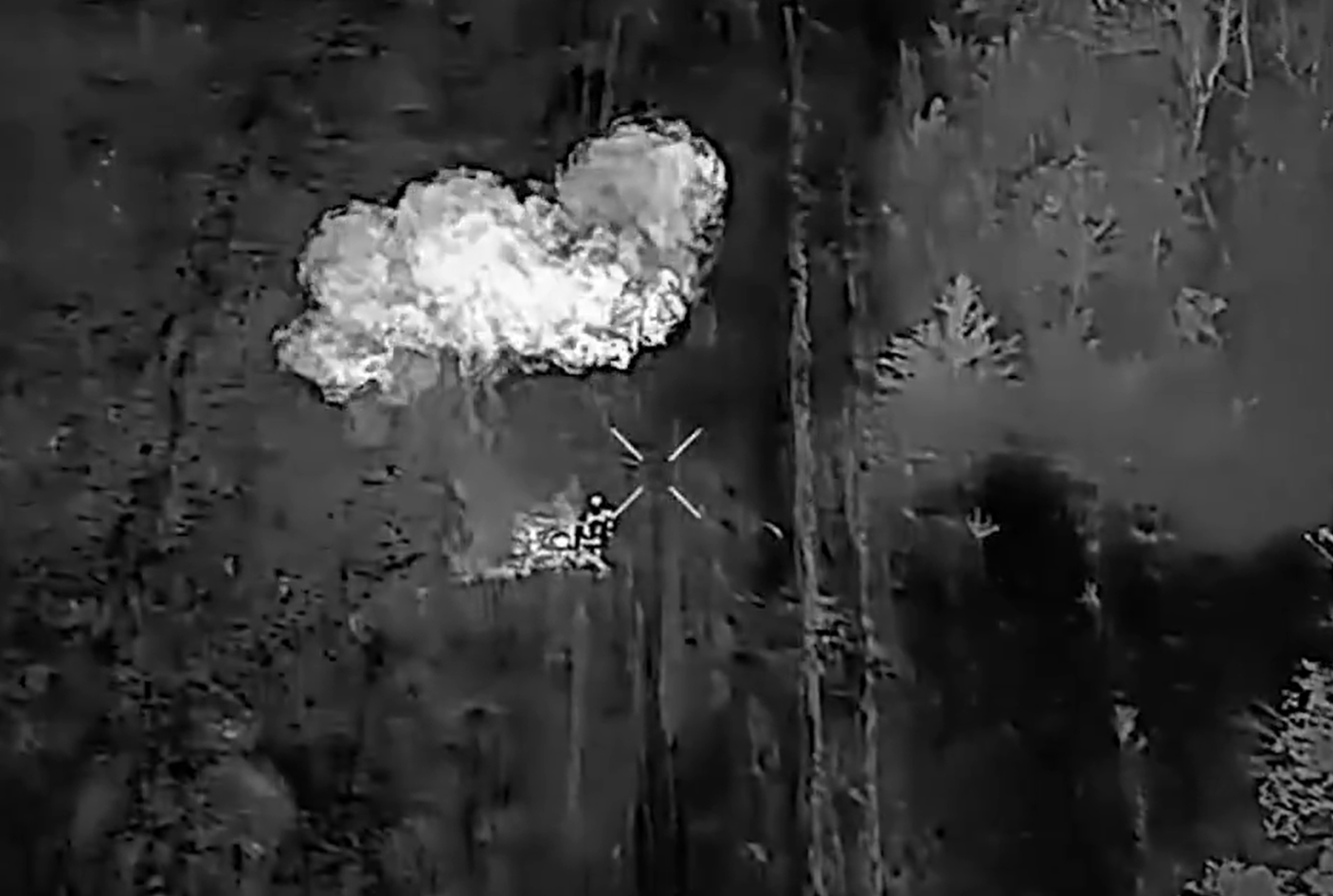
A Ukrainian ground robot struck two mines during an operation to evacuate a wounded soldier from the battlefield — but the soldier survived and another robot was able to complete the rescue.
Ukraine’s 66th Separate Mechanized Brigade released footage of the operation involving a Tarhan-200 unmanned ground vehicle, or UGV.
The first mine exploded underneath the robot while it was still travelling towards the wounded soldier. The vehicle survived the blast and continued its mission.
After reaching the soldier and taking him aboard, the Tarhan-200 struck another mine on the return journey.
The second explosion disabled the robot, but the wounded soldier was not injured by the blast, according to the brigade. Another unmanned ground vehicle was then dispatched, picked him up and successfully completed the evacuation.
The incident illustrates why ground robots are becoming increasingly important on a battlefield where both evacuation routes and the areas behind the front line are covered by mines, artillery and drones.
Robots are taking over dangerous frontline jobs
Ukraine has dramatically expanded its use of unmanned ground vehicles during 2026.
According to Ukraine’s Ministry of Defence, ground robots carried out more than 25,000 logistics and evacuation missions in August alone. Between January and the end of August, around 112,000 such missions were recorded in Ukraine’s DELTA battlefield management system.
Monthly use had more than tripled since January, when 7,511 missions were recorded.
Most of these machines are not autonomous combat robots in the science-fiction sense. Their most important work is more practical: carrying ammunition, food and water to exposed positions and bringing wounded soldiers back without sending additional troops into areas under constant Russian surveillance and attack.
Ukraine’s Defence Ministry has explicitly said that its objective is to shift as much frontline logistics as possible to robotic systems. UGVs are also increasingly being equipped for mine-clearing, engineering work, electronic warfare and direct combat roles.
The reason is simple: a destroyed machine can be replaced, while an evacuation team sent into the same area may create additional casualties.
Evacuations can take hours – and several robots
The Tarhan-200 incident is far from unique.
In June, Ukraine’s 110th Separate Mechanized Brigade described a 15-hour operation in which ground robots travelled a total of 56 kilometres to rescue two wounded soldiers who had been trapped for several days.
The first robot sent to them was destroyed by a Russian mine. A second machine was immediately dispatched and eventually reached the soldiers.
In September, Ukrainian troops used a single ground robot to evacuate four wounded infantrymen from the Huliaipole front in two separate trips. The machine was escorted by aerial drones and protected by interceptor drones because of the threat from Russian UAVs.
Other UGVs have survived direct attacks. In March, a Bizon robotic vehicle carrying a wounded soldier was struck by a Russian FPV drone during an evacuation on the Pokrovsk front but still managed to complete the mission.
Ukraine’s 1st Separate Medical Battalion said in September that its Maul evacuation robots had conducted hundreds of missions. Just over half were successful, with each robot evacuating an average of nearly two wounded soldiers during its operational lifetime.
The figures underline how difficult these missions remain. Ground robots can hit mines, lose communications, become stuck in difficult terrain or be hunted by Russian drones.
But the scale of their use shows that they have moved beyond experimental technology.
Ukraine is now integrating dedicated robotic units into combat formations, while military units can order UGVs directly through the Defence Ministry’s procurement system.
And where even ground robots cannot get through, Ukraine is beginning to look upward. In October, Ukrainian units reported several evacuations using heavy aerial drones after minefields, terrain and Russian FPV activity made ground rescue impossible.
A Ukrainian ground robot sent for a wounded soldier hit mines twice, once on the way and again with him aboard
— Euromaidan Press (@EuromaidanPress) October 30, 2026
The second blast disabled the Tarhan-200, but the soldier was unhurt. Another robot finished the evacuation
🎥 66th Separate Mechanized Brigade pic.twitter.com/uCXMX73q9A