
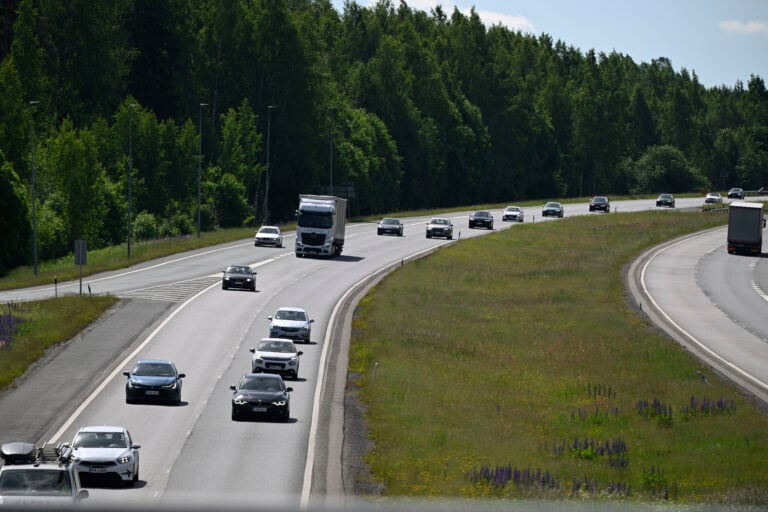
Finland needs to overhaul road taxation as the shift to electric vehicles erodes fuel-tax revenue, according to Palta, the association representing service-sector employers.
Palta has drawn up a detailed road-tax model that would shift the focus of taxation away from buying and owning a vehicle and increasingly toward how much it is used.
The organisation argues that reform is necessary because transport tax revenue is set to fall rapidly as the vehicle fleet becomes electrified, while the maintenance backlog on Finland’s road network continues to grow.
– We cannot base the financing of the transport system on a tax base that shrinks year after year. That is why road taxation must shift from buying and owning a vehicle toward its use, says Petri Laitinen, Palta’s director of transport and logistics.
Under the proposal, real road-transport tax revenue would be stabilised at the 2024 level of around €4 billion annually from 2029 onwards.
Palta says a decision should be made during the next government term, with the measures prepared over roughly 18 months. Because a technology-based mileage tax would take longer to introduce, the organisation proposes a two-stage transition.
At first, the basic annual vehicle tax on passenger cars and vans would be increased.
According to indicative calculations, the annual tax on an electric Fiat 600e would rise from €164 to €411. The same increase would apply to a Skoda Enyaq. For a diesel Skoda Octavia, the basic vehicle tax would rise from €111 to €277, although its separate power-source tax would be reduced slightly.
Mileage tax in the 2030s
In the permanent model, planned for the 2030s, the annual vehicle tax would be lowered and replaced in part by a new usage-based tax, potentially calculated according to kilometres driven.
Fuel taxes would also be reduced to prevent the new mileage charge and other already-decided measures from pushing up the total cost of driving combustion-engine vehicles and operating heavy transport too sharply.
Palta says the simplest and cheapest system would rely on odometer readings. Drivers would report their mileage themselves and the figures would be verified during vehicle inspections.
Kilometres driven abroad could be deducted through a dedicated mobile application.
An odometer-based system would not, however, allow taxation to vary according to where the vehicle was actually driven.
If regional differentiation were considered desirable, Palta says a tracking-device-based system could be introduced instead. Such a device could record where the car was driven rather than relying on the owner’s home address.
Only the information required to calculate the tax should be transmitted to the authorities.
– The digital implementation must be market-based and designed with data protection as a priority, Palta says.
Another option would be a hybrid model in which passenger cars and vans were taxed on the basis of odometer readings, while trucks and buses used tracking devices.
EV tax could reach 3.7 cents per kilometre
Palta is aiming for the permanent system to take effect in 2031, although it acknowledges implementation could take longer.
For 2031, it estimates the mileage tax at 1.7 cents per kilometre for petrol and diesel passenger cars, 2.7 cents for plug-in hybrids and 3.7 cents for fully electric cars.
Electric-car costs would therefore rise, although Palta says their combined tax and energy costs would still remain below those of comparable combustion-engine vehicles.
The organisation argues that the mileage tax should be higher for EVs because they do not pay fuel tax and the electricity tax collected relative to kilometres driven is small.
In Palta’s example, driving a diesel Skoda Octavia for 15,000 kilometres a year currently results in annual tax and energy costs of €1,631. Under the proposed 2031 system, the figure would rise to an estimated €1,892.
For a Skoda Enyaq EV, the equivalent annual cost would rise from €775 to €1,237.
That means the annual cost of the electric vehicle would increase by just over €460, while the diesel driver would pay roughly €260 more.
The figures do not include car tax, insurance premium tax, maintenance or insurance costs. Energy prices are based on a 36-month average ending in June 2026. Additional diesel costs arising from Finland’s fuel distribution obligation and the EU’s ETS2 emissions trading system are included.
Lower burden proposed for heavy transport
Under Palta’s model, the tax burden on heavy diesel vehicles would be reduced.
The aim would be to offset part of the cost increase expected in the coming years from the EU’s new emissions trading system and tighter fuel distribution obligations.
Usage-based taxation of electric and hydrogen-powered heavy vehicles would remain lighter than for diesel vehicles in order to encourage the transition to zero-emission transport.
Finland collected around €3.9 billion in specific road-transport taxes in 2024. Under current trends, real tax revenue is projected to fall by around €1 billion between 2025 and 2030.
Palta also proposes linking road-transport taxes to an index, arguing that inflation accounts for almost 30 percent of the decline in real tax revenue.
At the same time, the maintenance backlog on Finland’s transport infrastructure has already risen to €4.3 billion and could reach at least €6 billion by 2037 under current funding levels.
– The current transport tax system was built for a world in which cars run on petrol and diesel. Electrification changes that foundation. Taxation must change with it so that transport infrastructure can be financed without undermining Finland’s competitiveness, says Mikko Paloneva, Palta’s climate policy and sustainable growth specialist.
Palta says revenue collected from road transport should be directed more clearly toward maintaining and developing the road network and financing other transport-system needs.
It also stresses that the reform should preserve incentives to switch to cleaner powertrains and must not halt the electrification of transport.