
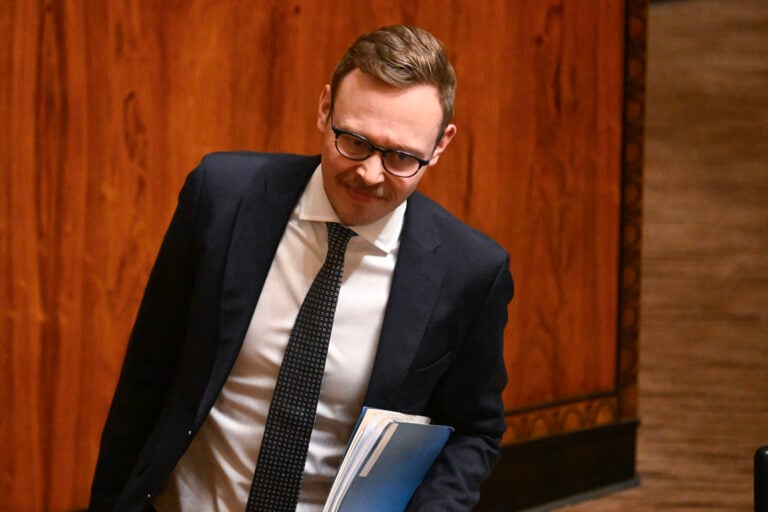
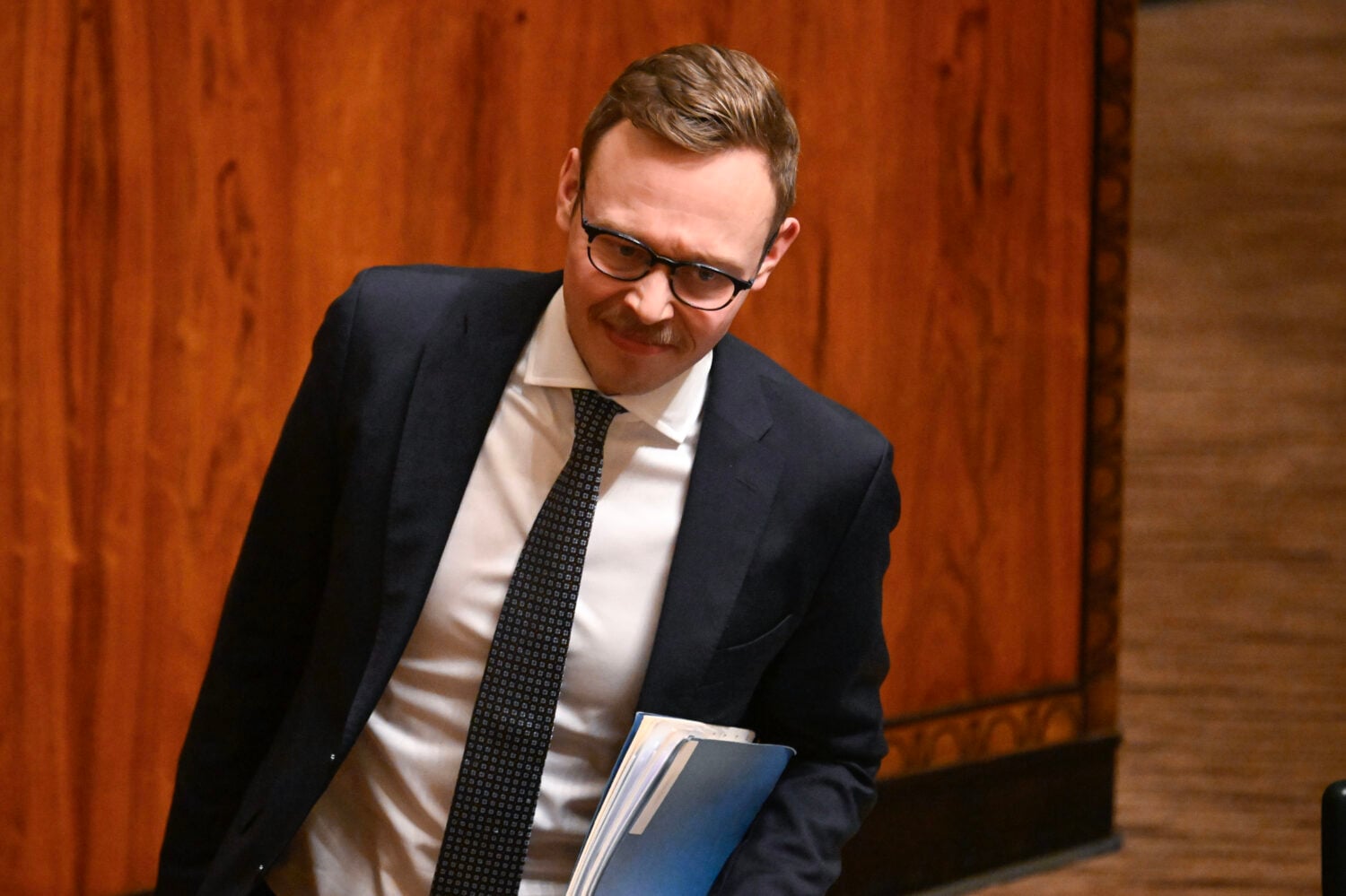
Finland’s Minister of Employment Matias Marttinen (National Coalition Party, NCP) says the Social Democratic Party’s (SDP) alternative budget undermines much of the criticism the main opposition party has directed at the government’s economic policy throughout the parliamentary term.
According to Marttinen, the Social Democrats have spent three and a half years criticising the government’s spending cuts and labour market reforms, only to accept many of them in their own budget proposal.
– It is now clear that SDP chair Antti Lindtman has made a complete U-turn, Marttinen says in an interview with Verkkouutiset.
Alternative budgets are proposals drawn up by opposition parliamentary groups as alternatives to the government’s budget proposal. In these documents, opposition groups present their own views on government revenue and expenditure, as well as their economic policy priorities.
The minister points out that the Social Democrats are now also seeking to curb growth in healthcare and social welfare expenditure and have accepted virtually all of the government’s social security cuts.
According to Marttinen, the opposition party is facing the same harsh fiscal realities as the government. Finland must take substantial measures to curb its growing public debt.
‘The worst possible tax policy’
In its alternative budget, the SDP proposes reversing the government’s corporate income tax cut, increasing taxation of dividends from unlisted companies and raising income taxes on high earners.
Marttinen is concerned not only about these proposals but also about the SDP’s longer-term fiscal policy. The party has suggested that future fiscal consolidation could be divided roughly equally between tax increases and spending cuts.
Finland’s overall tax burden is already among the highest in the European Union, the minister argues.
If Finland needs to consolidate its public finances by €8–9 billion during the next parliamentary term, the SDP’s approach would imply considerably larger tax increases than those proposed in its alternative budget.
– If the party is talking about tax increases of €4–5 billion, there is no magic pot of money or vast pool of wealthy Finns from whom such sums can be extracted, Marttinen says.
In his view, tax increases of this magnitude would inevitably affect ordinary consumers rather than just businesses, entrepreneurs and high-income earners.
Marttinen notes that Finland’s economy has returned to growth, exports are performing well and industrial companies are recruiting. However, uncertainty about household finances continues to hold back domestic consumption.
He points to neighbouring Sweden, where recovering domestic demand has helped improve employment.
– In this situation, proposing substantial tax increases that would effectively reduce domestic consumption would be the worst possible tax policy.
The effects would be particularly apparent in the service sector, where employment depends heavily on consumers’ purchasing power.
– It means fewer jobs in shops, restaurants and across the service sector.
Minister challenges opposition’s revenue estimates
Marttinen also questions the additional tax revenue that the Social Democrats and the Left Alliance expect to generate by increasing taxation of dividends from unlisted companies.
He argues that entrepreneurs would respond by withdrawing less money from their companies, potentially leaving the expected additional tax revenues unrealised while weakening incentives for entrepreneurship.
The SDP has defended its proposed reform on grounds including tax fairness.
Marttinen questions why opposition parties want to increase taxes on work and entrepreneurship when there is broad agreement on Finland’s need for more jobs and business activity.
– Under no circumstances will we introduce changes that increase the tax burden of any Finnish entrepreneur, he says of the National Coalition Party’s position.
Corporate tax cut aims to attract investment
The SDP has criticised the government’s decision to lower Finland’s corporate income tax rate from 20 to 18 per cent, describing it as an expensive and ineffective measure to promote growth.
Marttinen rejects that assessment. He argues that corporate tax rates influence both investment decisions and where multinational companies book their profits and pay taxes.
Finland’s geographical location, far from the major markets of Central Europe, makes it particularly important to offer companies a competitive business environment, he says.
The minister regularly meets investors and business representatives considering investments in Finland. In his view, a lower corporate tax rate sends a clear signal that Finland is an attractive investment destination.
Small and medium-sized enterprises would also benefit from having more money available for investment and business development, ultimately supporting job creation.
Marttinen warns against repeatedly changing corporate tax rates from one parliamentary term to the next, stressing the importance of a stable and predictable business environment.
He also criticises the SDP for opposing the government’s proposal to extend the period during which companies can carry forward tax losses to 25 years, a reform he describes as one of the key demands of Finnish startups.
National Coalition Party wants further tax cuts
Marttinen considers the Left Alliance’s alternative budget a more genuine departure from government policy than the SDP’s proposal, as the party would reverse all of the government’s spending cuts.
However, he strongly opposes its tax policy, pointing out that the proposed increases would affect people earning €4,000 a month, including middle-income professionals such as engineers, teachers and nurses.
The National Coalition Party, by contrast, wants to continue reducing taxes on work and entrepreneurship across all income levels.
It also wants the fiscal consolidation required during the next parliamentary term to be achieved entirely through spending cuts.
Marttinen rejects the SDP’s proposed 50–50 division between tax increases and spending cuts, describing it as highly detrimental to Finland.
He stresses that improving employment requires a recovery in domestic demand, which he believes would be severely undermined by billions of euros in tax increases.
– The tax policies of the Social Democrats and the Left Alliance would be the worst possible poison for Finland’s economic growth and employment.