
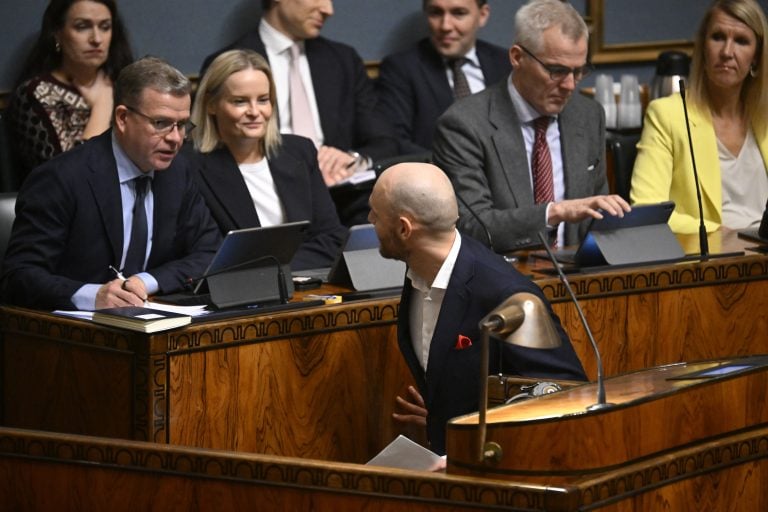
Finland’s government and opposition clashed in Parliament on Tuesday over the rising cost of living, with taxes, fuel prices, electricity bills and healthcare fees at the centre of the debate.
The discussion followed an opposition challenge to the government over how ordinary Finns are coping with higher everyday expenses.
The governing National Coalition Party defended its economic policy by arguing that Finland cannot sustainably respond to higher prices by increasing taxation or borrowing.
MP Timo Heinonen pointed to fresh Tax Administration figures showing that tax revenues have risen at the same time as the government has reduced taxation on work.
According to figures cited by Heinonen, the Tax Administration collected almost €66 billion between January and September, an increase of more than €2.3 billion or 3.7 percent from a year earlier. Personal income tax revenue rose by almost €1 billion.
“This is exactly the kind of development Finland needs,” Heinonen said.
“People keep more of what they earn, while more tax revenue is collected to finance common services.”
The figures alone do not show that tax cuts caused the increase in tax revenue. Heinonen nevertheless argued that they support continuing policies aimed at strengthening employment, investment and economic growth.
National Coalition attacks opposition tax plans
National Coalition parliamentary group deputy chair Pia Kauma focused her criticism on the Social Democratic Party.
Kauma said the government has reduced taxation on work by €1.5 billion during its term, with more than two-thirds of the cuts directed at low- and middle-income earners.
She accused the SDP of planning tax increases worth €4–5 billion and argued that increases on that scale could not be collected solely from high-income earners.
According to Kauma, higher taxation would weaken growth and make it more difficult for households already struggling with everyday expenses.
The National Coalition’s broader argument was that Finland’s strained public finances leave little room for large new support packages.
Kauma said Finland is still taking on more than €13 billion in new debt this year despite substantial fiscal adjustment measures.
She argued that the sustainable response to higher living costs is stronger economic growth, more jobs and improved household purchasing power rather than additional borrowing.
“We cannot take on more debt every time prices rise,” Kauma said.
The party also highlighted measures aimed at easing fuel costs for transport companies, agriculture and people with long commutes, as well as plans to increase weather-independent electricity production.
Opposition says government measures fall short
Opposition parties gave a sharply different account of the situation facing Finnish households.
The Centre Party accused Prime Minister Petteri Orpo’s government of being detached from the financial pressures facing ordinary people.
Centre MP Markku Siponen pointed to high fuel and electricity prices and argued that the government’s measures were insufficient, particularly for people living outside major cities who depend on private cars.
The Centre wants to increase taxes on electricity used by data centres while gradually removing household electricity tax. It has also proposed more generous commuting deductions and additional funding for road maintenance.
The Social Democratic Party likewise attacked the government over fuel prices and healthcare costs.
SDP MP Seppo Eskelinen said the government’s measures to reduce motoring costs would have little effect at the pump and criticised plans to finance part of the package through cuts to road maintenance.
SDP MP Piritta Rantanen focused on higher healthcare charges, arguing that repeated hospital visits can leave some families facing substantial bills.
The SDP maintains that government cuts to social security and higher service charges have weakened the position of ordinary households.
Finns Party turns criticism back on opposition
The Finns Party, the National Coalition’s main government partner, also attacked the opposition during the debate.
MP Mauri Peltokangas accused the SDP of contradicting itself by expressing concern about motoring and household costs while proposing policies that he said would increase them.
He pointed in particular to previous SDP proposals concerning fuel taxation and Finland’s renewable fuel distribution obligation.
Peltokangas argued that stricter climate policies could raise transport and energy costs and weaken the competitiveness of Finnish industry.
The opposition, meanwhile, argues that the government has itself made choices that increase costs for households through cuts, higher healthcare charges and changes to social benefits.
The debate therefore exposed a broader dividing line in Finnish economic policy.
The National Coalition and its government partners argue that lower taxes, investment and employment are the most sustainable way to improve household finances while bringing public debt under control.
The opposition argues that the government has placed too much of the adjustment burden on households already struggling with higher prices.
With Finland continuing to run a large public deficit, both sides agree that household finances remain under pressure. They disagree sharply over who should pay — and whether the answer lies in lower taxes and tighter spending or greater public support and a different distribution of the burden.
READ ALSO:
Tax cuts, higher revenues – Finland sees a Swedish-style surprise