
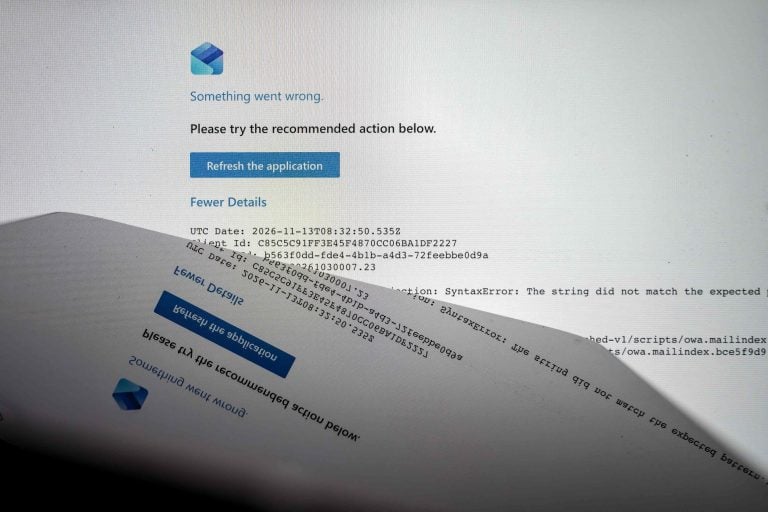
Cybersecurity company Check Point Software is warning that the major global Microsoft 365 outage could create fertile ground for phishing and other scams.
The disruption, which began on Thursday and continued into Friday, affected Outlook, Microsoft Teams, Copilot and a wide range of other Microsoft 365 services used by businesses, governments and public institutions around the world.
Check Point says criminals often exploit major outages by sending fake technical-support messages, fraudulent recovery links and requests involving passwords or payments.
– When email and authentication go down at the same time, people can lose access to services that appear to be completely unrelated. At the same time, criminals can take advantage of the confusion with fake support messages or recovery links, Check Point executive Charlotte Wilson said in a statement.
The company is urging organisations not to disable multi-factor authentication or other security controls in an attempt to work around the outage.
Requests to change passwords, permissions or payment details should also be verified through a separate communication channel.
Outage spread around the world
The scale of the disruption was unusually large.
Microsoft said the problems affected services connected to Exchange Online, including Outlook email as well as features in Teams, SharePoint, Microsoft 365 Copilot, Defender, Planner, Intune and Purview. Some Microsoft Defender for Office 365 customers were also affected by problems with Safe Links, a security feature designed to check potentially malicious URLs.
At the peak of the disruption, outage tracker Downdetector recorded more than 138,000 reports of Outlook problems in the United States alone. Reports came from dozens of countries, with users in 74 countries and territories reporting problems during the disruption.
The outage reached far beyond individual email accounts. Businesses and government agencies were disrupted in several countries. In Britain, the problems affected a court hearing and online police services, while Norwegian ministries, Singaporean government email systems, the Philippine Supreme Court and Japanese government systems were among those reporting disruption.
Microsoft 365 integrations used by OpenAI and Anthropic were also affected.
Microsoft said there was no indication that the outage itself had been caused by malicious activity. Engineers traced the technical problems to affected servers becoming overwhelmed and stopping processing requests, while efforts to restore capacity initially produced less improvement than expected.
By Friday, Microsoft was reporting improving availability in North America, Europe and the Asia-Pacific region, although some users could still experience intermittent access problems and delayed email while systems recovered.
Confusion creates an opportunity
Check Point warns that the consequences of such an outage can continue even after the underlying technical problem begins to ease.
When employees are expecting unusual messages about broken accounts or service recovery, a fraudulent email claiming to come from Microsoft, an IT department or another trusted provider may appear more credible than it normally would.
The company therefore recommends that organisations establish backup communication channels in advance. This can prevent employees from turning to personal email accounts or unauthorised messaging applications when corporate systems become unavailable.
Users should also be particularly cautious about messages asking them to log in again, reset a password, approve an authentication request or change banking or payment information while an outage is under way.
Microsoft's outage reports on November 12 reached 74 countries and territories in about an hour on Downdetector.
— Downdetector (@downdetector) November 12, 2026
Microsoft says its Exchange Online incident began at 16:17 UTC. Reports to Downdetector about Outlook began climbing at about 17:25 UTC, 12:25 in New York. By 18:25,… pic.twitter.com/7FQ4dDsfbm