
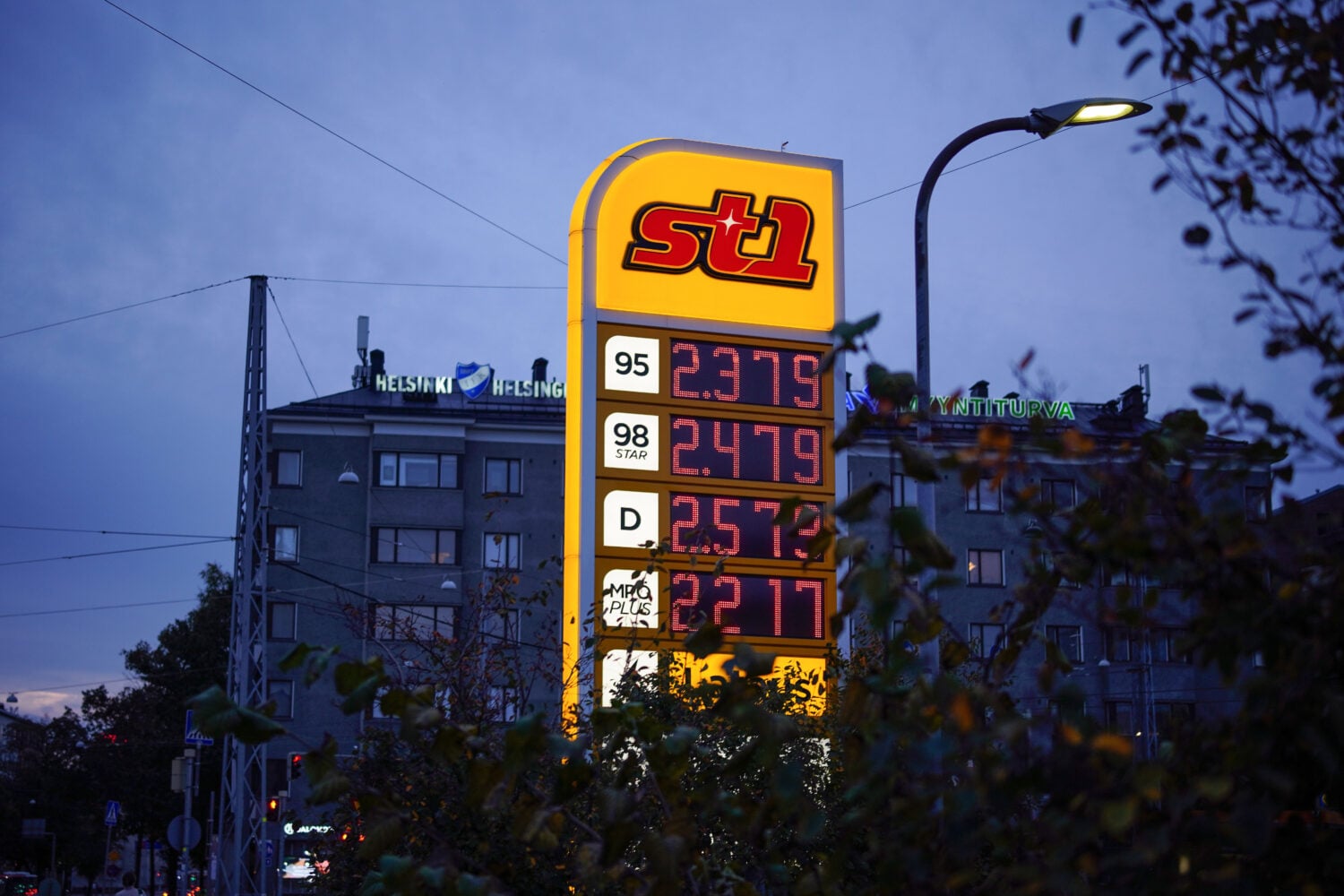
A dispute over fuel prices has intensified inside Finland’s government as coalition parties remain divided over how to ease costs for motorists, businesses and the transport sector.
Prime Minister Petteri Orpo has said the government could allocate around €60 million to measures aimed primarily at commuting and professional transport. According to Orpo, the National Coalition Party has already submitted a proposal accepted by the Swedish People’s Party and Christian Democrats, while the Finns Party has yet to approve it.
Social Security Minister Karoliina Partanen has accused the Finns Party of delaying relief for businesses.
“We in the National Coalition Party would already have wanted to bring relief to entrepreneurs,” Partanen wrote on X.
“Why aren’t the Finns Party on the side of entrepreneurs? Every day matters.”
The package under discussion has reportedly included a higher maximum tax deduction for commuting expenses as well as direct support for the transport sector and agriculture.
Dispute centres on renewable fuel obligation
The Finns Party has instead pushed for a reduction in Finland’s renewable fuel distribution obligation, which requires fuel suppliers to include a minimum share of renewable fuels in petrol and diesel.
National Coalition MPs have argued that such a change would be too slow and have only a limited impact on prices.
MP Pia Kauma cited an assessment by the Chemical Industry Federation of Finland, according to which lowering the obligation by one percentage point would cut pump prices by around 1.3 cents per litre only after a delay of several months.
For an average motorist driving 14,000 kilometres a year, the effect would be roughly €1 per month.
The federation says the current spike in fuel prices is mainly linked to international fossil fuel markets, including the crisis around the Strait of Hormuz and the effects of Russia’s war against Ukraine.
MP warns of energy security risks
National Coalition MP Pauli Aalto-Setälä, vice-chair of Parliament’s Commerce Committee, has now added an energy-security argument to the debate.
He says lowering the renewable fuel obligation could weaken Finland’s long-term energy self-sufficiency by reducing incentives for domestic renewable fuel production.
“Today’s extremely high prices are not caused by renewables, but by the rising cost of fossil fuels,” Aalto-Setälä said in a statement.
“Finland has no oil or gas fields of its own, so relying on fossil fuels always means dependence on imported energy.”
He argued that the current price shock should instead strengthen the case for maintaining incentives for domestic fuel production.
Aalto-Setälä also said a lower obligation would be a poor tool for addressing an acute price crisis because the effect would only reach consumers after a delay of several months.
The Chemical Industry Federation has made a similar argument, saying that changes to the obligation take time to feed through to retail prices because supply contracts are long-term.
Investment concerns
Aalto-Setälä also warned that frequent changes to the renewable fuel mandate could discourage investment.
He pointed to more than 40 planned biogas facilities in Finland, worth almost €900 million in total, as well as potential bio-refinery investments valued at more than €2 billion.
The wider industry has likewise argued that predictable regulation is important for renewable fuel investment. The Chemical Industry Federation says the obligation creates demand for alternatives to fossil fuels and reduces dependence on imported oil products.
The disagreement therefore now extends beyond the immediate question of pump prices. The governing parties are also arguing over whether short-term relief should come through direct support, taxation or changes to climate and energy policy.
For now, Orpo’s proposed €60 million package remains unresolved.