
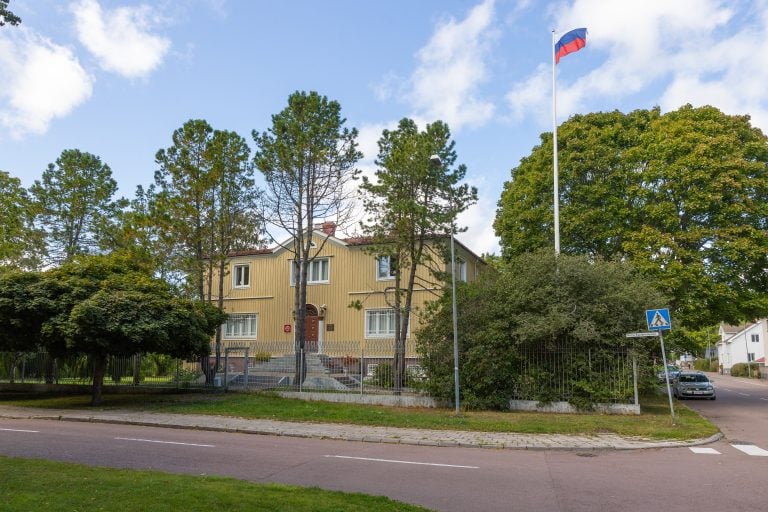
Security policy expert Henri Vanhanen argues that Finland should take advantage of the impending change of consul at Russia’s consulate in Åland. The current consul, Aleksandr Rogovin, has confirmed to Nya Åland that his term is coming to an end and that a new consul is expected to replace him.
In practice, Finland could refuse to approve the new consul and thereby make it more difficult for the consulate to operate. Vanhanen, however, believes a better option would be for Finland to take steps towards closing the consulate altogether.
Speaking in a Verkkouutiset Asiakysymys video interview, Vanhanen notes that there is also support in Åland for shutting down the Russian mission.
– From Russia’s perspective, Åland and Gotland occupy a strategically important position when it comes to the defence of Finland and Sweden. Russia also views the area in terms of its own sphere of interest and how it could operate in the Baltic Sea region during a military crisis. Intelligence services and their activities are also connected with consulates and their operations. That almost goes without saying, Vanhanen says.
Vanhanen stresses that the issue is not primarily about a threat posed by a single building. Rather, Russia, which is waging a war of aggression against Ukraine, continues to maintain a consulate in Åland that is entitled under a 1940 treaty to monitor compliance with the islands’ demilitarised status.
– Frankly, it feels grotesque.
Speed could be decisive in a crisis
Vanhanen says Finland should not only seek to remove the Russian consulate but also begin considering an end to Åland’s demilitarisation. He stresses that this would not mean interfering with the islands’ autonomy. The objective would be to make it possible to defend Åland fully in a crisis.
– Of course, we already have plans for defending Åland. That is not the issue. In modern warfare, however, the first hours, minutes and days are critical. Speed is essential. If we are too slow on Finnish territory, that becomes a problem for us.
Warnings about hybrid warfare and possible acts of sabotage have become increasingly common.
According to Vanhanen, Russia seeks to blur the boundary between war and peace. This also makes Åland, in his assessment, an attractive target for activities that fit Russia’s concept of strategic warfare.
Vanhanen argues that the changed security environment would justify a new review of Åland’s status. Finland conducted numerous studies on NATO membership before ultimately deciding to join the alliance, he notes. In the case of Åland, he says Finland should similarly act ahead of events rather than waiting until circumstances leave no alternative.
– If the concern is how Russia might react, Finland’s NATO membership was already the much bigger issue under the current circumstances, Vanhanen says.
He believes that now is the right moment to “remove the slack” from the arrangements surrounding Åland.
According to Vanhanen, decisions on the issue may be politically easier to make now than they would be several years from today.